Water does not wait for business hours. A supply line lets go on the 14th floor of a Midtown co-op at 2 a.m., and by sunrise, three units below are dealing with sagging ceilings and soaked hardwood. A summer cloudburst drops more rain in an hour than Brooklyn’s sewers can carry, and a ground-floor shop takes on six inches of gray water before the owner even hears about it.
These situations happen across the five boroughs every week. What separates a manageable repair from a months-long nightmare is usually the first 24 to 48 hours: who shows up, how fast, and whether they know what they are doing. Finding reliable water damage restoration experts in NYC before you need them is one of the smartest moves a property owner or manager can make.
This guide is written for homeowners, landlords, building managers, and commercial tenants who want to understand what actually happens during a water loss. It covers the causes that are specific to New York, what a proper restoration job looks like step by step, how to vet a contractor, and how to handle the insurance side without leaving money on the table. The goal is simple: when the water shows up, you should already know what to do next.
Navigating Water Damage Challenges in New York City
New York presents problems that a homeowner in a suburban ranch house never has to think about. Buildings share walls, floors, and plumbing risers. A leak in one apartment rarely stays in one apartment, which means a single incident can involve multiple owners, a co-op or condo board, a managing agent, and two or three insurance carriers, all at once.
Access is its own headache. Restoration crews have to deal with freight elevator schedules, building insurance certificates, doormen who need advance notice, and street parking that makes staging a truck-mounted extractor a real logistical puzzle. A contractor who has never worked in a Manhattan high-rise may lose hours just figuring out the building’s rules, and those hours matter when water is wicking up drywall.
Then there is the building stock itself. NYC has prewar walk-ups with plaster-and-lath walls, postwar towers with concrete slabs, brownstones with deep cellars, and new glass condos with complex mechanical systems. Each one dries differently. Plaster holds moisture longer than drywall. Concrete slabs can stay wet for weeks without proper equipment. Old hardwood floors over sleeper systems can trap water in places no one sees.
Finally, the stakes are higher here because space is expensive. A commercial tenant in SoHo losing a week of business, or a landlord unable to rent a unit for a month, feels the financial hit immediately. That is why speed, documentation, and building-specific knowledge matter so much more in this city than almost anywhere else.
Common Causes of Residential and Commercial Water Damage in NYC
Most water losses in the city fall into a handful of patterns. Knowing them helps you spot risk before it turns into a claim, and it helps you describe the problem accurately when you call for help.
The usual suspects include:
- Failed appliance connections: washing machine hoses, dishwasher lines, and refrigerator ice-maker tubes are frequent culprits in apartments.
- Toilet and drain overflows: especially in older buildings where shared stacks back up.
- Roof and facade leaks: flat roofs, failed parapet flashing, and deteriorated brick pointing let water in during heavy rain.
- HVAC and condensate issues: clogged drain pans and through-wall units can leak slowly for weeks.
- Sprinkler discharges: accidental or freeze-related sprinkler head failures in commercial spaces release a surprising amount of water fast.
- Sewage backups: basements and ground floors are vulnerable when the municipal system is overwhelmed.
Two causes deserve a closer look because they are so closely tied to how New York is built and where it sits.
Aging Infrastructure and High-Rise Pipe Bursts
A large share of the city’s buildings are decades old, and many still run on original galvanized steel or cast iron piping. Galvanized pipe corrodes from the inside, narrowing and weakening over time until a joint or section finally fails. Cast iron waste lines crack. Old shutoff valves seize, so even when someone spots a leak, they cannot stop it quickly.
High-rises add pressure, literally. Water systems in tall buildings use pumps and pressure-reducing valves, and when one of those components fails, fixtures and lines on certain floors can see pressure spikes. Winter brings its own risk: pipes running along exterior walls or through unheated spaces can freeze and split during a cold snap.
The real problem in a tower is gravity. A burst on a high floor travels down through ceilings, light fixtures, and wall cavities, sometimes affecting many units before it is shut off. Every one of those units needs moisture mapping and drying, not just the one where the pipe broke.
Flash Flooding and Storm Surge Impact
Hurricane Sandy in 2012 showed how coastal surge can swamp Lower Manhattan, Red Hook, the Rockaways, and Staten Island. The remnants of Hurricane Ida in 2021 showed a different danger: intense rainfall falling faster than drainage can handle, filling basement apartments in Queens and Brooklyn within minutes.
That second pattern is the one many property owners underestimate. You do not need to live near the water to flood. Heavy cloudbursts overwhelm combined sewers, and water comes up through floor drains and toilets or pours down exterior stairwells and window wells.
Floodwater and sewer backup are classified as Category 3, or “black water,” under industry standards. It carries bacteria and contaminants, which means porous materials like carpet, padding, and lower drywall usually have to be removed rather than dried. Treating storm water like a clean pipe leak is one of the most common and costly mistakes.
The Multi-Step Professional Restoration Process
A proper restoration job follows a sequence, and skipping steps is how mold and repeat damage happen. The industry reference point is the IICRC S500 standard for water damage restoration, which lays out how water should be categorized, extracted, and dried. Any serious contractor works from it.
Broadly, the job moves through these phases:
- Inspection, source control, and safety checks
- Water extraction
- Removal of unsalvageable materials
- Structural drying and dehumidification
- Cleaning, sanitizing, and odor treatment
- Final moisture verification
- Repairs and reconstruction
Emergency Assessment and Water Extraction
The first visit should start with stopping the source and making the space safe. That means confirming the water is shut off, checking for electrical hazards, and identifying the water category. Clean supply water, gray water from appliances, and black water from sewage each call for different handling.
Next comes moisture mapping. Technicians use moisture meters and infrared cameras to trace where water has actually traveled, which is often far beyond the visible puddle. In apartments, this frequently means checking the units below and beside the source. Good crews photograph and log readings from the start, because that record supports the insurance claim later.
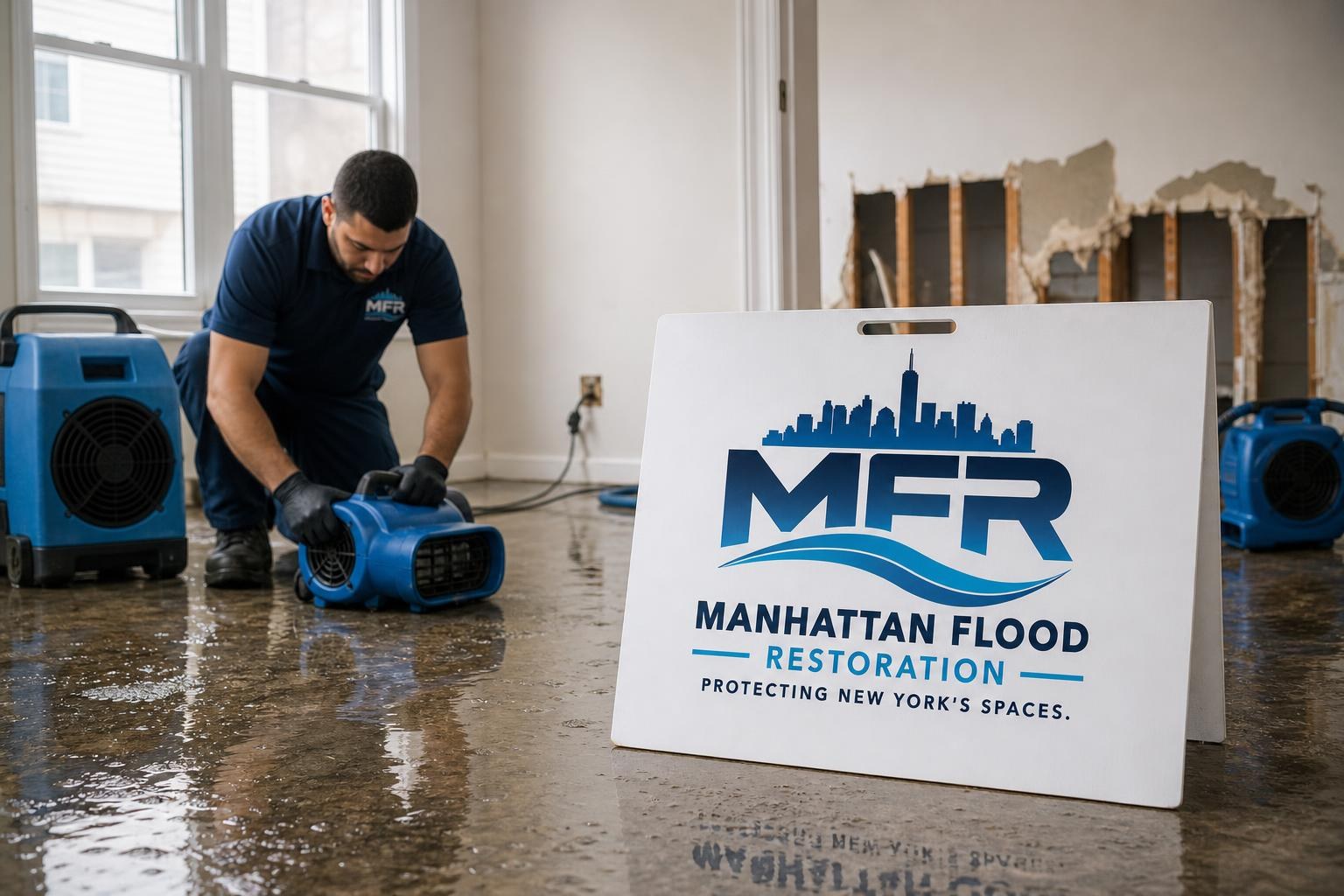
Then the water comes out. Truck-mounted or portable extractors pull standing water from floors and carpets far faster than wet vacs. Removing liquid water quickly matters because extraction is far more efficient than evaporation. Every gallon pulled out by a machine is a gallon the dehumidifiers do not have to remove from the air over the next several days.
Industrial Dehumidification and Structural Drying
Once standing water is gone, the hidden moisture remains in drywall, subfloors, framing, and concrete. Drying it requires a balanced system of air movers and commercial dehumidifiers, sized to the affected area and the materials involved.
Air movers push air across wet surfaces to speed evaporation. Dehumidifiers then pull that moisture out of the air so it does not just settle back into the structure. Low-grain refrigerant and desiccant dehumidifiers each have their place; desiccants are often better for cold spaces or dense materials like hardwood and concrete.
Technicians may drill small holes at the base of walls or remove baseboards to push air into cavities. In many cases, this lets them save drywall that would otherwise be torn out. Drying typically takes three to five days for clean water losses, though plaster, masonry, and hardwood can take longer. The job is not done until meter readings show materials have reached their normal dry standard, not just when surfaces feel dry to the touch.
Mitigating Secondary Risks: Mold and Structural Decay
Water itself is only part of the damage. What follows it can cost more than the original leak.
Mold is the obvious threat. The EPA’s general guidance is that wet building materials should be dried within 24 to 48 hours to prevent mold growth. In a humid NYC summer, or in a closed-up apartment while the owner is traveling, growth can start quickly inside wall cavities and under flooring where no one sees it until a musty smell appears.
New York State takes mold seriously. Under the state’s mold law, mold assessment and remediation work on projects over ten square feet must be performed by licensed professionals, and the assessor and remediator on a project cannot be the same company. That separation exists to prevent conflicts of interest, and it is worth knowing before you hire anyone who offers to both test and fix the problem.
Structural decay is slower but just as serious. Wood framing and subfloors that stay damp lose strength and can rot. Steel fasteners and joists corrode. In older masonry buildings, repeated water intrusion can damage mortar and contribute to facade problems. Ceilings saturated with water can sag and collapse, which is a genuine safety hazard.
Signs that secondary damage may be developing include:
- A musty or earthy odor that lingers after cleanup
- Bubbling paint, peeling wallpaper, or soft spots in drywall
- Warped, cupped, or buckled floorboards
- Dark staining that spreads or returns after cleaning
- Doors that suddenly stick in their frames
If you see any of these weeks after a “fixed” leak, the drying was probably incomplete. Get a moisture inspection before closing up walls or installing new finishes.
Criteria for Selecting Reliable NYC Restoration Experts
Plenty of companies advertise water damage services. Far fewer have the training, equipment, and city-specific experience to handle a co-op riser leak or a flooded commercial basement properly. When you are searching for reliable water damage restoration NYC experts, a few questions separate real professionals from the rest.
Ask any company you are considering:
- Do you follow IICRC standards, and are your technicians certified?
- Do you carry general liability and workers’ compensation insurance, and can you issue a certificate for my building?
- Will you document moisture readings and photos daily?
- How do you handle work in co-op and condo buildings with board requirements?
- Will you work directly with my insurance adjuster?
Be cautious of anyone who pressures you to sign an assignment of benefits on the spot, quotes a flat price without inspecting, or cannot explain how they will verify that materials are dry.
IICRC Certification and Licensing Standards
The Institute of Inspection, Cleaning and Restoration Certification (IICRC) is the main credentialing body in the field. Look specifically for Water Restoration Technician (WRT) and Applied Structural Drying (ASD) certifications on the crew, and Applied Microbial Remediation Technician (AMRT) training for mold work. Certification means the technicians have been trained on the standards insurers and adjusters expect.
Licensing matters too. Contractors doing home improvement work on residential property in NYC generally need a Home Improvement Contractor license from the Department of Consumer and Worker Protection. Mold work requires the state licensing described above. Ask for license numbers and verify them yourself; it takes five minutes and can save you a major dispute later.
24/7 Availability and Response Time Metrics
“24/7 service” is easy to claim and harder to deliver. A real emergency line connects you to a person who can dispatch a crew, not an answering service that promises a callback in the morning.
Ask specific questions: What is your typical arrival time in my borough at night? Do you have equipment staged locally, or is it coming from New Jersey or Long Island? How many active jobs can you support at once during a major storm? A good answer for Manhattan is usually a crew on site within an hour or two, with extraction starting on the first visit. Companies like Manhattan Flood Restoration that operate locally have a built-in advantage here, since they are not fighting bridge and tunnel traffic to reach you.
Navigating Insurance Claims for Water Damage
Insurance is where many property owners lose money they are entitled to. The process rewards people who document well and understand their policy.
Start with the coverage basics. Most standard homeowners, condo (HO-6), and renters policies cover sudden and accidental water damage, such as a burst pipe or appliance failure. They typically exclude gradual leaks, poor maintenance, and flooding from surface water or storm surge. Flood coverage usually requires a separate policy, often through the National Flood Insurance Program. Sewer backup is often excluded unless you added a specific endorsement.
In co-ops and condos, responsibility is split. The building’s master policy may cover common elements and original fixtures, while your unit policy covers improvements, contents, and sometimes walls-in. Read your proprietary lease or condo bylaws so you know where the line falls before arguing with anyone.
A practical sequence after a loss:
- Stop the water and make the area safe.
- Photograph and video everything before cleanup begins, including damaged items.
- Notify your carrier and your building’s managing agent promptly.
- Call a restoration company to begin mitigation. Insurers expect you to prevent further damage, and delays can hurt your claim.
- Keep damaged materials or samples until the adjuster has seen them, unless they pose a health risk.
- Save every receipt, including hotel stays if the unit is unlivable.
A restoration contractor who provides daily moisture logs, photos, and itemized estimates in formats adjusters recognize makes the claim far smoother. That paper trail is often the difference between a fast settlement and a long back-and-forth over whether drying was “necessary.”
If your claim is denied or underpaid, you have options. You can request the adjuster’s reasoning in writing, submit additional documentation, or hire a licensed public adjuster who works for you rather than the insurer.
Advanced Technology Used by Top-Tier NYC Specialists
The tools in a modern restoration truck look very different from a decade or two ago. Good equipment does not replace skilled technicians, but it lets them find problems faster, dry more precisely, and prove their work.
Common equipment on a well-run job includes:
- Pin and pinless moisture meters for measuring moisture content in wood, drywall, and masonry
- Thermo-hygrometers for tracking temperature, humidity, and grains per pound in the air
- Low-grain refrigerant and desiccant dehumidifiers matched to the conditions
- Wall cavity and floor drying systems that inject or pull air through tight spaces, often saving finished floors and walls
- HEPA air scrubbers to capture airborne particles and spores during demolition
- Remote monitoring sensors that report conditions so technicians can adjust equipment without unnecessary visits
Remote monitoring is especially useful in NYC, where every site visit means elevator bookings and building access coordination. Fewer unnecessary trips means less disruption for residents and neighbors.
Thermal Imaging for Hidden Moisture Detection
Infrared cameras are among the most useful tools a restoration technician carries. They detect temperature differences on surfaces, and because evaporating moisture cools materials, wet areas often show up as cooler patches on screen.
In practice, a technician can scan a ceiling below a leaking apartment and see the outline of where water has spread across the drywall, even when the paint looks perfectly fine. They can trace moisture along a wall cavity, under tile, or behind cabinets without tearing anything open first.
Thermal imaging has a limit: it shows temperature, not moisture directly. Cold drafts, insulation gaps, or air conditioning ducts can create similar patterns. That is why skilled technicians confirm what the camera suggests with a moisture meter. The combination lets them map damage accurately, remove only what truly needs to go, and document the extent of the loss for insurance with images adjusters can understand at a glance.
Restoring Your Property to Pre-Loss Condition
Drying is the midpoint, not the finish line. Once readings confirm materials are dry, the reconstruction phase begins: replacing drywall and insulation, refinishing or replacing flooring, repainting, reinstalling cabinets and trim, and treating any lingering odors. In a co-op or condo, this often means coordinating with the board on approved materials and working hours.
The goal is “pre-loss condition,” which means the space should look and function as it did before the water arrived. Matching finishes in older buildings takes care, whether that is blending new plaster with original walls or sourcing hardwood that matches a 1920s floor. Choosing one company to handle both mitigation and rebuild usually reduces gaps, finger-pointing, and delays between trades.
The biggest lesson from all of this is timing. The 24 to 48 hours after water appears decide whether you are drying a few walls or tearing out a kitchen. Picking qualified restoration experts in advance, knowing your policy, and documenting from minute one put you in control of a situation that feels uncontrollable.
If you are dealing with a burst pipe, flooded basement, sewage backup, or storm damage anywhere in Manhattan or the surrounding boroughs, call Manhattan Flood Restoration’s emergency line. A local crew can assess the damage, start extraction, and handle the drying, mold prevention, and rebuild so your home or business gets back to normal. Save the number now, before the next storm makes the decision for you.